

Sapling issue #849
The one in which we talk to emerging author Holli Carrell.

Hi writers.
I enjoyed this recent interview with short story writer Bret Anthony Johnston (who, I learned, typically writes 20-25 drafts of each story!) and wanted to share. Also, the folks at Pop Culture Happy Hour weigh in on “What makes for a good book to film adaptation?”
Now, here’s what’s happening in the small press world this week.
—Kit
Managing Editor / Sapling editor
Black Lawrence Press
Contest: Modern Haiku Robert Spiess Memorial Award Haiku Competition

Genre(s): poetry
Award: First Prize $100; Second Prize $50; Third Prize $25. Up to five poets will be awarded Honorable Mentions.
Entry Fee: $1 for each entry; up to five entries accepted per poet
Deadline: March 13, 2026
Guidelines: modernhaiku.org/spiesscontest/spiesscontest2026
Journal: aaduna

Genre(s): fiction, creative nonfiction, poetry, visual art
Website: aaduna.net
Guidelines: aaduna.net/submission-process
Open through March 14, 2026 for the summer issue
Small Press: Gaudy Boy / Singapore Unbound

Genre(s): poetry, fiction, and literary non-fiction
Website: singaporeunbound.org
Guidelines: singaporeunbound.org/submissions
Currently accepting manuscript proposals for fiction or literary non-fiction.
Gaudy Boy Poetry Book Contest deadline June 1, 2026.
Feature: Sapling’s Five Burning Questions for Emerging Writers: Holli Carrell
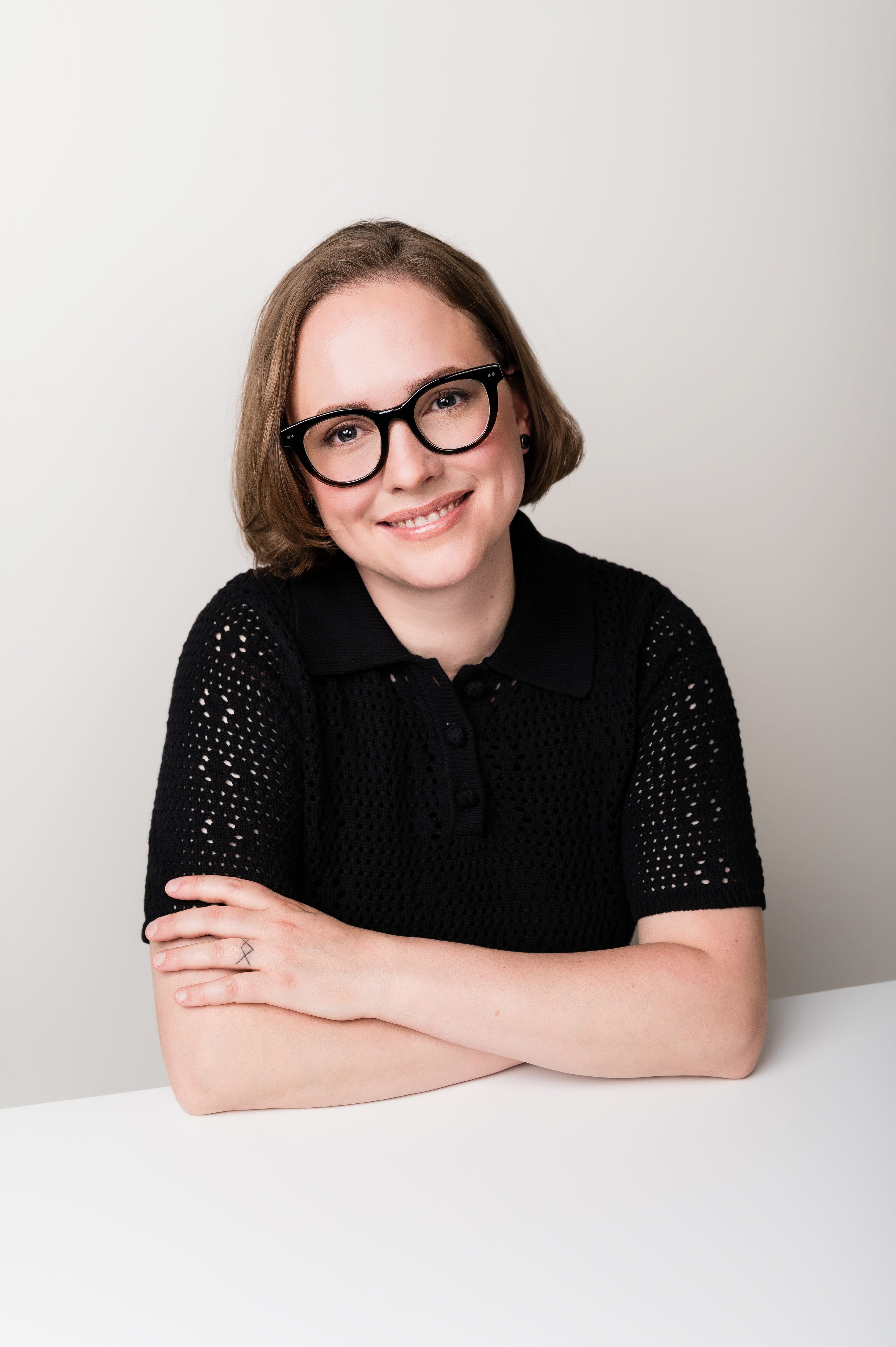
This week, Sapling spoke with Holli Carrell, author of the debut poetry collection Apostasies (Perugia Press, September 15, 2025).
SAPLING: Tell us about the process of getting your debut collection, Apostasies, out in the world. Did you enter contests? Open reading periods? What transpired between sending the manuscript out initially and its acceptance at Perugia Press?
HOLLI CARRELL: In 2020, I began submitting an early version of the book to contests—a manuscript radically different from what Apostasies is today, with only about 40% of the final poems. Nothing came of it. I now see that as a blessing; the book simply wasn’t ready. Between 2021 and 2023, I didn’t submit at all, wrote very little, and often questioned whether I would continue the project. During this time, I was struggling with burnout and felt very discouraged.
It was a challenging period, but in late 2023, I hit a good stride and wrote 60% of the final poems in just six months. I then immediately began submitting the finished book to contests and a few open reading periods. I was very fortunate—Apostasies was accepted by Perugia Press within four months and was also named a finalist and semifinalist in several other contests. When I received the offer from Perugia, I was genuinely thrilled and did not hesitate to withdraw my submissions from other pending opportunities. Perugia felt like a perfect fit for Apostasies: a feminist, nonprofit press deeply invested in elevating the voices of women-identified and gender-nonconforming poets, with a tight-knit, nurturing community and an incredible list of books and authors I admire.
SAPLING: What was your experience with the editing of your manuscript after its acceptance? Did you have an opportunity to make revisions, either at your own suggestion or at the suggestion of your editor? How involved were you in the design aspects of the book’s production (cover image, interior design, and so on)?
H. C.: After the book was accepted, I worked closely with Perugia Press’s editor and director, Rebecca Hart Olander, for about two months on copyediting and proofreading. Rebecca is an astute and perceptive editor with an exceptional eye for detail, and I’m very grateful for the care and attention she brought to my work—Apostasies is stronger because of it. I also had the opportunity to suggest minor changes to the version of the book I initially submitted and felt very supported throughout the process.
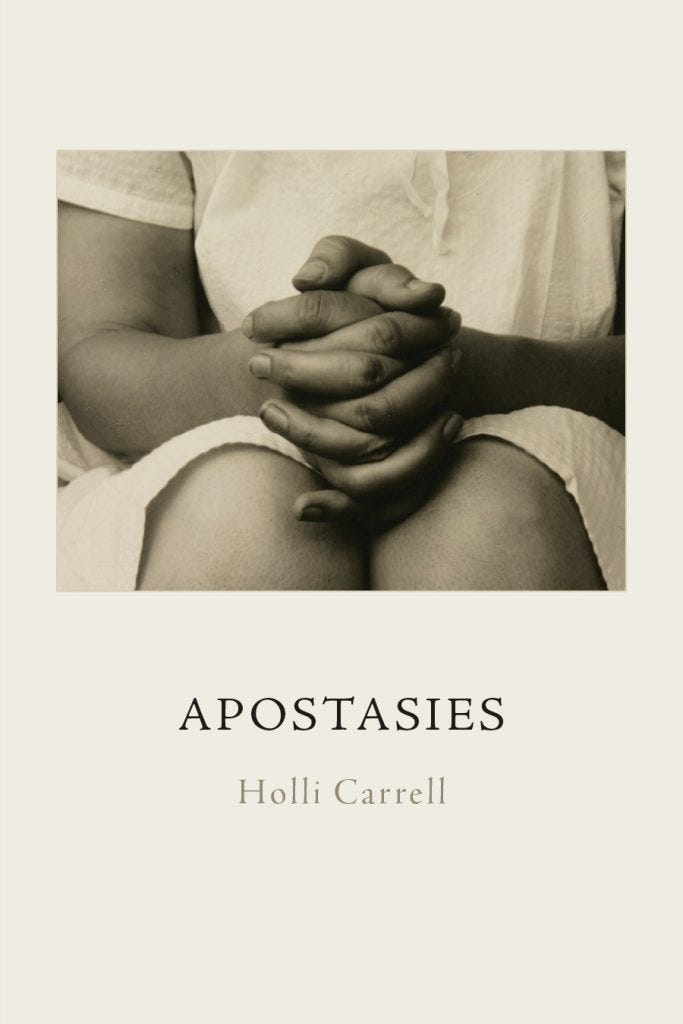
Design and layout were major undertakings for Apostasies. Before the book was accepted by Perugia, I was concerned that I would have to eliminate many of the important visual and textual elements—images, erasures, charts, and typographic choices—that make the book what it is. Working with Perugia proved to be a true gift: Rebecca and Jeff Potter, Perugia’s designer, welcomed and celebrated my choices, pouring so much labor and artistry into the book, and making it more beautiful than I could have dreamed. I never had to compromise my vision, which I know is very rare and lucky. The image on the book’s cover was also my suggestion. I feel very fortunate to have been so closely involved in the design process from start to finish!
SAPLING: Did you publish a number of poems in literary journals or other periodicals before the publication of the finished book? Did this seem like a necessary part of the process for this particular project?
H. C.: About half of the poems published in Apostasies appeared in journals, mostly older poems written before 2023. I think publishing poetry in journals before launching a debut can be important for emerging poets because it helps build readership and relationships with editors and publications. It was also encouraging for me to see a response to my work while I was working on the project in isolation for such a long stretch.
SAPLING: In what ways have you been involved in the publicity and promotion of Apostasies? In what ways has the publisher contributed to marketing and publicity efforts?
H. C.: Perugia truly invests its time and energy in supporting and celebrating its authors, both online and at events. As a small press, they are very active on social media, have an impressive reach, and have connected me with readers and communities I otherwise wouldn’t have found on my own. The marketing team also dedicated significant time and resources to outreach with media outlets, potential reviewers, and institutional organizations for readings and workshops. Asterism Books, Perugia’s distributor, also helped promote Apostasies on the marketing side.
Inevitably, though, most small press authors also need to be actively involved in their books’ outreach—and perhaps it would be helpful for first-time authors to know more about this. For me, this has involved reaching out to institutions, local reading series, and literary organizations I’m connected with or adjacent to in Ohio and Utah. I also organized my local book launch and am still pitching my book to opportunities as they arise.
SAPLING: What surprised you about the process of having your book published? Is there anything you wish you’d known beforehand about putting a first book out into the world and/or publishing with a small press?
H. C.: The most surprising and gratifying aspect of publishing my first book has been, without a doubt, the connections and relationships I’ve made with readers. Before Apostasies was published, I wondered if the book’s very niche and personal subjects—Mormonism, religious surveillance, gender dysphoria, and doubt—would connect with others. The level of support I’ve received has been astonishing for me, both from individuals with similar religious backgrounds and from others with very different experiences. I am truly grateful.
As for something I wish I had known before publishing my book: I think I carried a silly assumption (a wish?) that as soon as my first book was published, everything would magically snap into focus in my life, with accompanying song and lights, and any doubts or insecurities I had would immediately fall to the wayside, because I would be— finally— a published author and 1,000,000% self-actualized. The truth is that a book is just a book; it isn’t magic. Once you dispel it from your body and release it into the world, the doubts continue, and the hard work of writing and searching must continue, too—just in a new form.
SAPLING: Bonus number six—In addition to your work as a poet, you are also a manuscript reader for Acre Books. Have you found that your experience on the editorial side provided any insights, comforts, or guidance when it came to submitting your own work?
H. C.: I didn’t begin reading manuscripts for Acre until after Apostasies was accepted for publication, so my work there doesn’t factor into my experience with my first book. However, I will say that the main realization I’ve had while working as a manuscript reader is that there is just an astonishing amount of brilliant, deserving, innovative work out there. We’re all very lucky to be living in this era of poetry, and I do consider it an immense privilege and honor to be involved in the publishing process.
SAPLING: Holli, thank you so much for sharing your journey to publication with Sapling readers!
Holli Carrell (she/they) is the author of Apostasies, winner of the 2025 Perugia Press Prize. She holds a Ph.D. in Creative Writing and Literature and a Graduate Certificate in Women’s, Gender, and Sexuality Studies from the University of Cincinnati— where she was a 2024-2025 Taft Research Center Dissertation Fellow— as well as an M.F.A. from Hunter College. Her writing has appeared or is forthcoming in publications such as Fence, Gulf Coast, 32 Poems, Poetry Northwest, The Journal, Bennington Review, and Ninth Letter, among others. She currently serves as a manuscript reader for Acre Books.
Give the gift of Sapling.
Would a writer in your life enjoy a gift subscription? You can send one for either $5/month or $50/year. All you’ll need is the gift recipient’s email.
Love this interview so much, Kit! Thank you for showcasing Holli and her incredible work at Sapling!